
The genes
How breeding works
Heirbloom uses real Mendelian genetics. Here's how a cross works, with the actual numbers.
Two copies of every gene
Every flower in Heirbloom carries two copies of each of its genes, one from each parent. When you cross two flowers, each parent puts one of its two copies into the seed, picked at random. That's all a cross is.
A wild flower, from the shop or found growing wild, is labelled Wild. Its seedlings are F1, their seedlings F2, and so on. Every flower keeps its parents on its card, so you can trace a line back to the wild ones it started from.
Dominant and recessive
For most genes one copy wins. If a flower has one copy for solid petals and one for an eyed ring, it shows solid: solid is dominant and the eye is recessive. The eye isn't gone. It's still in the seed's genes, waiting.
Patterns rank like a ladder. From strongest to weakest: solid, blotched, striped, speckled, eyed, veined, bicolor, rayed, picotee, tipped and ombré. A flower shows the strongest pattern it carries. So a picotee needs two copies of picotee, or picotee with tipped or ombré under it.
Petal shapes work the same way: round beats pointed, pointed beats frilled, frilled beats star.
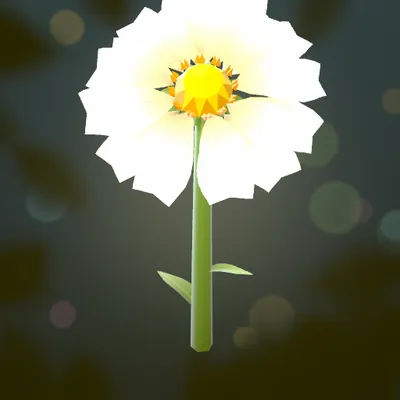
White Round DaisySolid. Could be hiding an eye Common 
White Round DaisyEyed in lemon. No solid copy Rare
Carriers and the test cross
A flower that hides a recessive copy is a carrier. You can't see it, but when two carriers cross, about one seed in four gets the hidden copy from both sides and shows it.
When a seedling shows something neither parent showed, the game works backwards: both parents must have carried it, so their cards now say so.
To check a flower you're unsure about, cross it with one that shows the trait. If it carries the trait, about half the seedlings show it. If none do after a few seeds, it probably doesn't. Growers call this a test cross. Mendel used it on his peas in the 1860s.
When both copies show
Not every gene has a winner. Size is a blend: two copies for large make a large flower, two for small make a small one, and one of each makes a medium. Cross two mediums and you get roughly one large, two medium and one small in every four.
Doubled petals add up too. One copy gives a semi-double, a second ring of petals; two copies give a full double. That's why roses and peonies, which carry a lot of doubling in the wild, so often come up semi-double.
Colour has two switches
A flower's petals only take a strong colour if two separate genes are both switched on. Call them the colour switch and the pigment switch. A flower needs at least one working copy of each. If either is off on both copies, the petals stay white, cream or pale yellow.
This has a famous result. Cross two coloured flowers that each carry one off copy of each switch, and only 9 seeds in 16 are coloured; the other 7 come out pale. William Bateson and Reginald Punnett found exactly this in sweet peas in 1906: two white parents gave purple children, which gave purple and white grandchildren in a 9 to 7 split.
Once the switches are on, other genes choose the colour. One pigment gene leans toward blues and purples, another toward reds and pinks, and the blue one wins when both are there. A flower with neither leans to orange and scarlet.
Shades from many genes
How deep a colour runs isn't one gene. Three depth genes each add a little or take a little away, and two more tilt it warmer or cooler. Seedlings don't sort into neat boxes, they spread over a range of shades, and most land near the middle. The palest and the deepest take patience: you keep the darkest seedling, cross it again, and creep toward the end of the range.
A worked example
Take two daisies. Both are solid white, both medium-sized, and both carry a hidden eye: each has one solid copy and one eyed copy (S/e), and one large and one small copy (L/l). Each parent passes on one copy of each gene at random.
| Parents | S | e |
|---|---|---|
| S | S/S solid | S/e solid |
| e | S/e solid | e/e eyed |
| Parents | L | l |
|---|---|---|
| L | L/L large | L/l medium |
| l | L/l medium | l/l small |
The two genes are passed on separately, so you multiply. A large eyed daisy is 1 in 4 times 1 in 4: 1 seed in 16. Three seeds in four come up solid, like their parents. Two of every three of those solid seedlings are carriers themselves.
In the wild, an eyed daisy is a rare find. Two carriers get you one in four. That's what breeding buys you.
Why a cross can surprise you
Every flower is hiding half its genes, and you only see the winners. Two red flowers can both carry white. Two plain ones can both carry stripes. A cross deals out copies you've never seen in either parent, which is the whole fun of it.
The F2, a cross of two F1s, is where it gets lively. Traits the grandparents showed and the F1 hid come back, mixed in new ways. Breeders grow out lots of F2 seedlings for exactly this reason.
Now and then a gene copy changes as a seed forms. The change is inherited like any other, so a new line can start from one seed. A few patterns and petal shapes only turn up this way, and only when the right parents meet. I'll leave those for you to find.
Read on
 The traits
 The species